Universal Dream Symbols vs Personal Meaning: Which Wins?
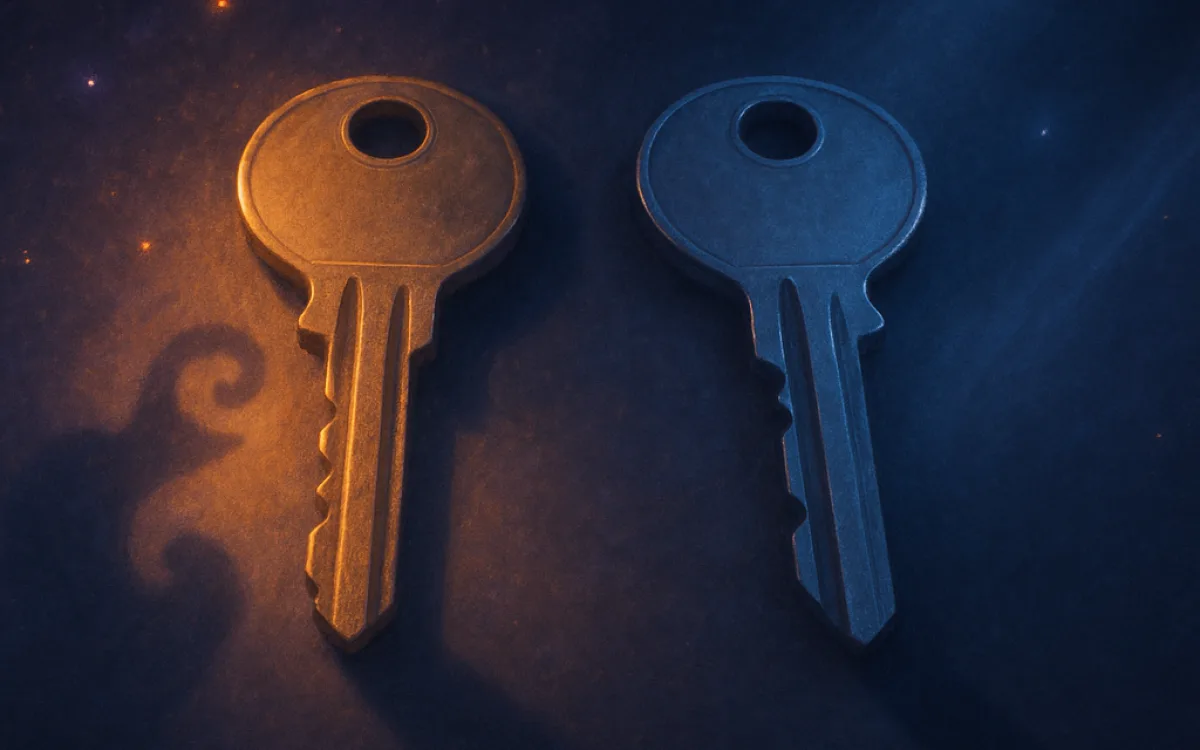
Two claims are both true and they sound contradictory. Certain dream images appear in every culture that has been studied — falling, being chased, teeth, water, arriving unprepared. And the meaning of any one of those images in your dream is decided by your life, not by the shared pattern.
Holding both at once is the whole skill. The shared pattern narrows the field; your associations pick the answer.
What is genuinely shared#
Cross-cultural surveys of dream content find a small set of themes reported almost everywhere, in similar proportions. That consistency is real and it is not mystical: human bodies, human fears and human social life have a lot in common.
- Falling, and the jolt that wakes you at the edge of sleep.
- Being chased or pursued, usually without seeing the pursuer clearly.
- Teeth loosening, crumbling or falling out.
- Being unprepared — the exam, the stage, the presentation.
- Being naked or exposed in public.
- Water in some form, from still pools to floods.
- Flying, one of the few widely reported pleasant themes.
Shared frequency is not shared meaning. Everyone dreams of falling; what falling is about differs from person to person.
Where the shared meaning ends#
A symbol is a container. Its shape is common, its contents are yours. The clearest demonstration is the snake: a threat in much of Europe, a guardian or a symbol of healing elsewhere, an ordinary animal to a herpetologist, and a specific memory to someone who was bitten as a child. Four people, one image, four different dreams.
| Image | Common reading | When your life overrides it |
|---|---|---|
| Snake | Threat, or transformation | You keep reptiles; you were bitten; a snake is a family emblem |
| Water | Emotional state | You nearly drowned; you are a swimmer; you live through floods |
| Teeth | Control, appearance, ageing | You had dental surgery last month |
| A house | The self, with rooms as parts | You are moving; you are in a property dispute |
| Being chased | Avoidance | You were followed once, for real |
How to weigh them in practice#
Use the common reading as a starting hypothesis and let your associations confirm or overturn it. In practice that is a short sequence.
- Note the image and, if you know it, the common reading.
- Before accepting it, write your own first association — the thing the image reminds you of unprompted.
- If your association carries the dream’s emotion, it wins. Every time.
- If you have no association at all, the common reading is a reasonable placeholder.
- Mark it as a placeholder in your journal, so you do not later mistake a guess for a finding.
Why dream dictionaries feel accurate#
They read well for the same reason horoscopes do. The entries are broad enough to apply to almost anyone — you are going through a period of change, something in your life feels out of your control — and the mind is very good at supplying a matching example. That is the Barnum effect, and it is not a reason to throw the whole idea out. It is a reason to demand specificity: a reading that could not apply to your neighbour is worth more than one that could.
Test any reading with one question: could I hand this to a stranger and have it fit them equally well? If yes, it has told you nothing about you.
Building your own symbol vocabulary#
After two or three months of journalling, your own dictionary starts to appear, and it beats every published one. You will find that stairs turn up in weeks when you are being assessed, or that a particular childhood street means you are worrying about money. These personal correspondences are far more reliable than universal ones, because they were derived from your own data rather than from a tradition.
Frequently asked questions
Are there universal dream symbols?
There are universal dream themes, which is a slightly different thing. Falling, being chased, teeth, exams, nakedness and water are reported across cultures at similar rates. What is not universal is what those themes mean for a given dreamer. Treat a shared theme as an indication of which broad concern is active, then find its specific content in your own life.
Should I trust a dream dictionary?
As a source of hypotheses, yes; as a source of answers, no. Dictionary entries are usually broad enough to fit almost anyone, which is what makes them feel uncannily accurate. Use one to widen your thinking when you are stuck, then apply the specificity test: if the reading would fit a stranger just as well, it has not told you anything about you.
How do I find my own meaning for a symbol?
Write the image, then write the first thing it reminds you of without editing. Do not reach for a meaning — reach for a memory. Then check whether that memory carries the same feeling the dream did. Over a few months a journal will show you your own recurring correspondences, and those are considerably more reliable than any published list.
dream symbolsuniversal dream symbolspersonal dream meaningdream dictionary accuracywhat does a snake mean in a dreamdream symbolism